Arc Flash Protection Devices Comparison: Absorber, Relay & Switchgear Solutions
Key Takeaways
- Passive arc energy absorbers clear an internal arc in 0.3-0.8 ms with zero detection delay, no auxiliary power and no firmware to fail; relay-based systems need 6-25 ms including breaker opening.
- Active arc flash relays add zone coordination and SCADA visibility, but introduce sensor, power-supply and trip-coil failure points documented in CIGRE WG B3.04.
- Integrated switchgear solutions cost 2-3x more than retrofit and usually require new equipment, so they are impractical for budget-constrained upgrades.
- Recommended architecture: hybrid — passive absorbers for sub-millisecond local clearing plus relays for zone coordination, validated to IEC 61641.
According to IEEE 1584-2018, arc flash incidents cause more than 2,000 serious injuries and 50+ fatalities annually across industrial power systems worldwide. In medium voltage (MV) and high voltage (HV) installations, an uncontrolled internal arc fault can release energies exceeding 400 kJ in under 10 milliseconds — enough to rupture switchgear walls, create supersonic pressure waves, and generate temperatures above 30,000°C.
Three mainstream arc flash protection architectures exist today: passive arc energy absorbers, active arc flash relay systems, and integrated switchgear solutions. Each operates on fundamentally different principles, with distinct trade-offs in speed, reliability, installation complexity, and cost. This article provides an engineering-focused comparison to help electrical designers, EPC contractors, and facility operators make informed selection decisions.
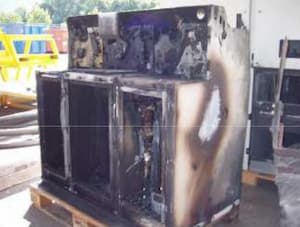
1. Passive Arc Energy Absorbers (Arc Capture)
Working Principle
Passive arc energy absorbers — also known as arc capture devices or short-circuit energy absorbers — operate purely on the thermal and pressure energy of the arc itself. They contain a high-conductivity metal chamber designed to capture the arc within a sealed ceramic/composite housing. The arc energy is absorbed by the chamber and converted harmlessly to thermal energy, while overpressure is safely vented or contained.
Unlike any electronic protection device, passive absorbers require zero detection time and zero power supply. They react within sub-millisecond range — typically 0.3 to 0.8 milliseconds — because the arc itself initiates the protection mechanism.
Key Advantages
- Fastest possible response: 0.3–0.8 ms vs. 3–10 ms for electronic relays
- Immune to cyberattacks: No electronics, no firmware, no network connections
- Zero maintenance: No moving parts, no batteries, no sensors to recalibrate
- Self-resetting: After absorbing the arc, the device automatically resets
- Minimal installation: Mounts directly in switchgear cubicle, no wiring needed
Limitations
Passive absorbers protect localized zones only — one device per switchgear cubicle. They do not coordinate with upstream protection relays or provide remote monitoring data. For complete busbar-level protection, multiple units are required.
ADAT Power's Short-circuit Energy Absorption & Release Device represents this category, tested per IEC 61641 internal arc fault standards with protection ratings up to 50 kA for 1 second.
2. Active Arc Flash Relay Systems
Working Principle
Active arc flash protection uses optical sensors (UV/IR light detection) or current/voltage signatures to detect arc initiation, then sends a trip signal to upstream circuit breakers. Detection typically takes 1–5 ms, plus an additional 5–20 ms for the breaker to open — total fault clearing of 6–25 ms.
Key Advantages
- Zone coordination: Can protect multiple cubicles or entire bus sections from one controller
- Remote monitoring: Provides real-time status data and event logs via SCADA
- Selective tripping: Can distinguish between internal arcs and external switching arcs
- Self-test capability: Relay can run periodic sensor health checks
Limitations
Critically, active relay systems introduce multiple failure points: sensor cable breaks, power supply outages, firmware bugs, communication delays, and breaker trip coil failures. In a safety analysis by CIGRE Working Group B3.04, 12% of active arc flash protection installations experienced a non-functional state due to maintenance gaps or component failures.
Additionally, the response time — while fast — is 5–25x slower than passive absorbers. For high-energy faults above 25 kA, this latency means the arc already damages switchgear before tripping occurs.
3. Integrated Switchgear Solutions
Working Principle
Premium switchgear manufacturers offer factory-integrated arc flash protection combining both passive absorbers and active relays in a complete package. The switchgear enclosure itself is engineered with pressure relief vents, internal arc barriers, and coordinated protection schemes.
Key Advantages
- Optimized enclosure design: Pressure vents, partition walls tested per IEC 61641
- Factory-calibrated coordination: Protection settings matched to enclosure characteristics
- Full compliance documentation: Type-test reports included
Limitations
Integrated solutions are the most expensive option — typically 2–3x the cost of retrofitting existing switchgear. They require purchasing entirely new equipment, making them impractical for retrofit projects or budget-constrained upgrades.
Side-by-Side Comparison
| Parameter | Passive Arc Energy Absorber | Active Arc Flash Relay | Integrated Switchgear |
|---|---|---|---|
| Response Time | 0.3–0.8 ms | 6–25 ms | 5–15 ms |
| Protection Coverage | Per cubicle | Per zone | Full enclosure |
| Maintenance Required | None | Annual inspection | Annual inspection |
| External Power | Not needed | Required (110/220V DC) | Required |
| Cyber Risk | None | Medium | Medium |
| Installation | Retrofit-friendly | Wiring intensive | New installation only |
| IEC 61641 Tested | Yes (component level) | Yes | Yes (full enclosure) |
| Relative Cost | 1x | 1.5x | 2–3x |
| Remote Monitoring | No | Yes | Yes |
Selection Guide: Which Solution for Your Application?
Scenario 1: Retrofit of Aging Switchgear
For substations with 15–30 year-old switchgear, passive arc energy absorbers are the optimal choice. They can be installed during planned maintenance outages in 2–4 hours per cubicle, at 30–50% of the cost of replacement. The [ADAT Power switchgear arc flash protection solution](switchgear-arc-flash.html) has been deployed successfully on 12kV to 40.5kV retrofits across Asia and the Middle East.
Scenario 2: New Construction with SCADA Integration
For new substations requiring remote monitoring, active relay systems combined with passive absorbers provide the best architecture: passive devices handle the sub-millisecond local protection, while relays provide zone coordination and SCADA integration for upstream breaker tripping and alarm management.
Scenario 3: Critical 24/7 Operations
Data centers, petrochemical plants, and critical infrastructure facilities benefit from the hybrid approach: passive absorbers ensure zero-downtime arc protection immune to power outages or cyber incidents, while fiber optic temperature sensors (see insulation fiber temperature monitoring) provide continuous busbar and cable condition monitoring.
Frequently Asked Questions
Q: What is the fastest arc flash protection device?
A: Passive arc energy absorbers respond in under 1 millisecond with zero detection delay. They are the fastest arc flash protection technology available because they require no electronic detection — the arc's own energy triggers the protection mechanism.
Q: Do arc energy absorbers require maintenance?
A: No. Passive arc energy absorbers contain no electronics, batteries, sensors, or moving parts. They are 100% maintenance-free and self-reset automatically after absorbing a fault arc.
Q: Can arc flash protection be added to existing switchgear?
A: Yes. Compact passive absorbers can be retrofitted into most medium voltage switchgear cubicles during planned maintenance outages. ADAT Power's engineering team provides free feasibility assessments for retrofit projects.
Need Technical Advice for Your Arc Flash Protection Project?
Our engineering team provides free arc flash risk assessments, protection device selection recommendations, and retrofit feasibility reviews for MV/HV switchgear installations worldwide.
Contact ADAT Power Engineers →
Disclaimer: This article is for engineering reference only. All arc flash protection installations should be performed by qualified personnel following local electrical safety standards (NFPA 70E, IEC 62443, IEEE 1584). Always verify compliance with applicable regional codes.
Published: November 3, 2026 · Company: ADAT Power (Wuxi) Technology Co., Ltd.